
Hydrogen Chloride Gas vs. Hydrochloric Acid: Industrial Supply Differences That Matter
Buyers who source chemicals by the truckload run into a naming problem early. The same two letters, H and Cl, appear on the safety data sheets for two materials that behave nothing alike on a production line.
The distinction between hydrogen chloride and hydrochloric acid isn't a matter of semantics for a procurement team. The form you specify determines your packaging, your handling materials, your transport classification, and, in many processes, whether the reaction works at all.
Below, we lay out the chemical distinction in plain terms, then show where each form is the right call across real industrial processes, and close with the supply chain details that decide whether bulk hydrogen chloride gas reaches your plant in a usable, documented condition.
The Core Distinction Between the Two Forms
So, what is hydrogen chloride? It is a colorless, corrosive, nonflammable compound with the formula HCl and a molecular weight of 36.46. In its pure form, it exists as hydrogen chloride gas, also called anhydrous hydrogen chloride because no water is present. The term anhydrous is the entire point: the molecule carries no water.
What is hydrochloric acid, then? It is the same HCl molecule dissolved in water to form an aqueous solution, commonly supplied at concentrations such as 31 to 37 percent.
Once HCl is introduced to water, it dissociates into hydrogen and chloride ions, giving the solution its strong acidity. The dissolved form is liquid at ambient conditions, ships in lined totes and tankers, and behaves as a mineral acid rather than a reactive gas.
What This Means for Procurement Teams
That difference, water present or water absent, has direct and measurable consequences.
Gaseous hydrogen chloride can act as a dry reactant in moisture-sensitive synthesis. Hydrochloric acid cannot, because it carries water into every reaction it touches. The presence or absence of water also dictates which metals survive contact, which is why the two forms travel through entirely different piping and storage systems.
A supply decision that treats them as interchangeable will introduce water into a process that cannot tolerate it, or specify exotic alloys when standard ones would do.
Where Anhydrous HCl Gas Is the Only Correct Choice
In a large set of processes, HCl gas is a requirement, and aqueous acid is ruled out before the conversation starts. These are applications where any water at all degrades the product, the equipment, or the reaction itself. Three stand out for the volume and the precision they demand.
Chlorosilane Synthesis In Semiconductor Manufacturing
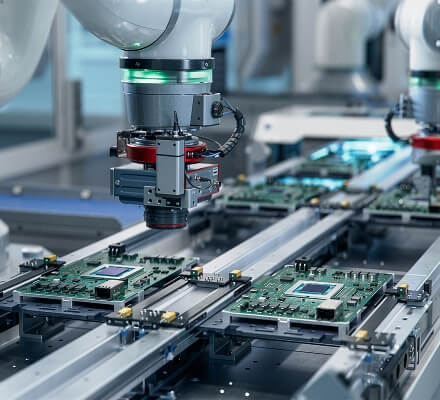
The clearest case for dry HCl is its use in semiconductor manufacturing. Trichlorosilane, the precursor for the polysilicon and epitaxial layers that underpin chip production, is produced by reacting hydrogen chloride gas with metallurgical-grade silicon.
The chemical vapor deposition (CVD) steps that follow are unforgiving of moisture, because water oxidizes silicon surfaces, seeds particulate defects, and ruins film uniformity.
Pharmaceutical Synthesis Under Anhydrous Conditions
Many pharmaceutical synthesis routes run under strictly anhydrous conditions, often in organic solvents where the active chemistry would be quenched or redirected by water. Hydrogen chloride gas is used to form hydrochloride salts of drug compounds, to catalyze reactions, and to adjust conditions without diluting the reaction mass.
Substituting aqueous acid would introduce moisture into reactions designed to exclude it, shifting yields and creating impurity profiles that complicate downstream purification and regulatory documentation.
Gas-Phase Chlorination In Petrochemical Production
In petrochemical operations, anhydrous HCl gas serves as a reactant and a processing agent in gas-phase chlorination and oxychlorination. The chlorination of light hydrocarbons, such as methane, produces chloromethanes, and HCl is consumed or regenerated in these loops.
Running these reactions in the gas phase keeps the system dry, preserves catalyst life, and avoids the corrosion that wet acid would drive through the reactor train.
Where Hydrochloric Acid Is the Better Fit
Knowing when to use hydrochloric acid is just as important as knowing when to avoid it. The hydrochloric acid applications that dominate industrial demand share a common trait: water is either harmless or actively helpful.
- Metal pickling is the largest by tonnage: Steel producers immerse product in hydrochloric acid baths to strip oxide scale before cold-rolling, galvanizing, or coating. The aqueous solution carries and rinses away dissolved iron salts.
- Water treatment is the second: Hydrochloric acid is dosed for pH adjustment and regeneration of ion-exchange resins, where the goal is to add acidity to an already aqueous system.
- Food-grade and other regulated aqueous uses round out the list: Hydrochloric acid is used in starch and sweetener processing, gelatin production, and similar applications where a controlled-concentration liquid is the specified input.
Supply Chain Realities for the Gaseous Form
Specifying anhydrous hydrogen chloride is the first decision. Getting it to a plant in usable condition is the second, and it is where most of the operational complexity sits.
Packaging and Volume
Bulk demand is met through a ladder of formats:
- Hydrogen chloride gas cylinders in the 200 or 300 size handle smaller continuous draw and laboratory-scale redistribution.
- Ton containers, often called Y cylinders at roughly 600 pounds of contents, serve mid-volume consumption.
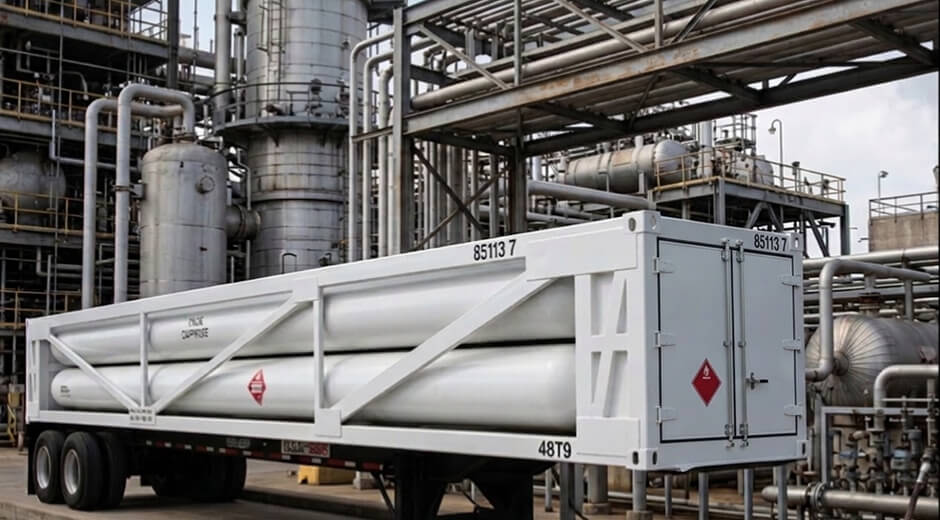
- For sustained high-volume demand, high-pressure tube trailers and ISO containers move product by the truckload.
Buyers consuming at production scale should match the format to their draw rate and storage footprint rather than defaulting to cylinders, because cylinder-handling labor and changeover frequency become hidden costs at scale. For operators who manage other liquefied gases alongside HCl, the same logistics planning extends to formats such as ISO containers across a broader fleet.
Purity Grades
Anhydrous HCl is supplied from 99.5 percent technical grade up to 99.999 percent electronic grade, with intermediate options at 99.9 and 99.995 percent. Technical grade is suitable for chemical synthesis and as a pickling feedstock. Electronic grade is the specification for semiconductor service, where trace metals, moisture, or hydrocarbons would damage a wafer. Over-specifying wastes budget and under-specifying scraps product, so the grade is a direct line item rather than a formality.
Materials Compatibility
Dry and wet HCl demand different handling systems, and the dividing line is moisture. Truly anhydrous hydrogen chloride gas is compatible with carbon steel and 316 stainless steel, which is why dry gas lines are economical to build. Introduce even trace amounts of water, and the gas becomes hydrochloric acid at the pipe wall, which pits stainless steel and drives chloride-stress corrosion cracking. Wet or uncertain service, therefore, calls for nickel alloys such as Hastelloy C-276, or for non-metallic systems.
Aqueous hydrochloric acid handling, by contrast, commonly runs through schedule 80 PVC and lined piping. The takeaway for a buyer is that the moisture specification of the gas dictates the capital cost of the handling system, so purity and metallurgy decisions must be made together.
Regulatory and Transport Requirements
Anhydrous hydrogen chloride is regulated as a DOT Class 2.3 toxic gas, with a Class 8 corrosive subsidiary hazard. That classification governs cylinder and container specifications, valve outlets such as CGA 330 and DISS 634 for the highest grade, transport documentation, placarding, and on-site storage requirements.
What to Look for in an Anhydrous HCl Supplier
A few criteria separate a supplier built for this product from a general gas provider:
- Documentation: Certificates of conformance and analysis tied to each grade, with traceability that follows the product through any downstream repackaging.
- Verified Purity: Certification that rests on analytical testing rather than a nominal label, particularly for electronic-grade material.
- Supply Security: Inventory and logistics that hold specification through production ramps and seasonal swings.
- Handling Expertise: A supplier fluent in corrosive service can advise on container compatibility and transfer practices that protect both your gas integrity and your equipment.
Frequently Asked Questions About Hydrogen Chloride Gas vs. Hydrochloric Acid
Semiconductor processes generally require electronic-grade anhydrous hydrogen chloride, typically 99.999 percent (5.0 grade), and in some cases 99.995 percent (4.5 grade). At these grades, trace moisture, metals, and hydrocarbons are held low enough to protect wafer surfaces and deposition film quality. Technical grades are not suitable, because their impurity ceilings are too high for chlorosilane synthesis and the deposition steps that follow.
Source Anhydrous HCl Gas from Gas Innovations
Gas Innovations supplies anhydrous hydrogen chloride across all four purity grades from a location near the Houston Ship Channel, with high-pressure cylinder packaging, ton containers, tube trailers, and ISO containers sized to production demand. Every shipment is backed by the documentation, purity certification, and corrosive-service infrastructure these applications require.
If you're scoping a new supply program or reviewing your current source, we can help you match grade, packaging, and volume to your process. Contact our team today.